Saturday, 23 March 2013

Off site exhibition.

So in our tutor groups we were given the task of setting up an off site exhibition. We split ourselves up into smaller groups according to what we wanted our exhibition space like. Some people wanted a typical white cube gallery space, some to work with something not so typical and some wanted an outside space. I went into the group of wanting a not so typical gallery space. We came together and discussed various places we could have the exhibition and who would contact these places. 

One place we decided to have a look at was Cable night club under london bridge. It was a great venue that would have been a great challenge to put an exhibition together in and we managed to get about 15 + people that were interested in showing there. Initially we were told we would have to pay a certain amount for the hire which was doable as we had a big group and that we would need to manage to get a certain bar tab on the night. However these fees increased as time went on and it became too much of a financial risk for people so we had to abandon that idea. 

This was our original poster we made for the exhibition at cable. 


We then had little time to arrange a new venue. My friend Jo had worked at a bar called Grand Union Kennington and now worked at the Camden branch and she suggested asking if we could have an exhibition in their upstairs space. They said yes and we managed to get the space for free to have it for one day/evening. It was a lot smaller space than Cable and we thought it was less ambitious but we didn't have time to sort anywhere else. Due to the smaller space we could only have about 5ish people showing in the spaceto give each other enough room. It ended it being me, Joanna Penso, Simone Barnes and Bethany Travis. This worked out to be a nice size group actually and we worked well together as a group.

We decided to curate the show together and when we went to visit it seemed pretty easy to decided where each of our works were to go and decided if that didn't work on the day we set the exhibition up we would just try out a new way.


The upstairs inside part of the bar where we had our exhibition. The doors to the left led our the the outside tent area. 
The bar Grand Union where we had our exhibition in the upstairs bit.

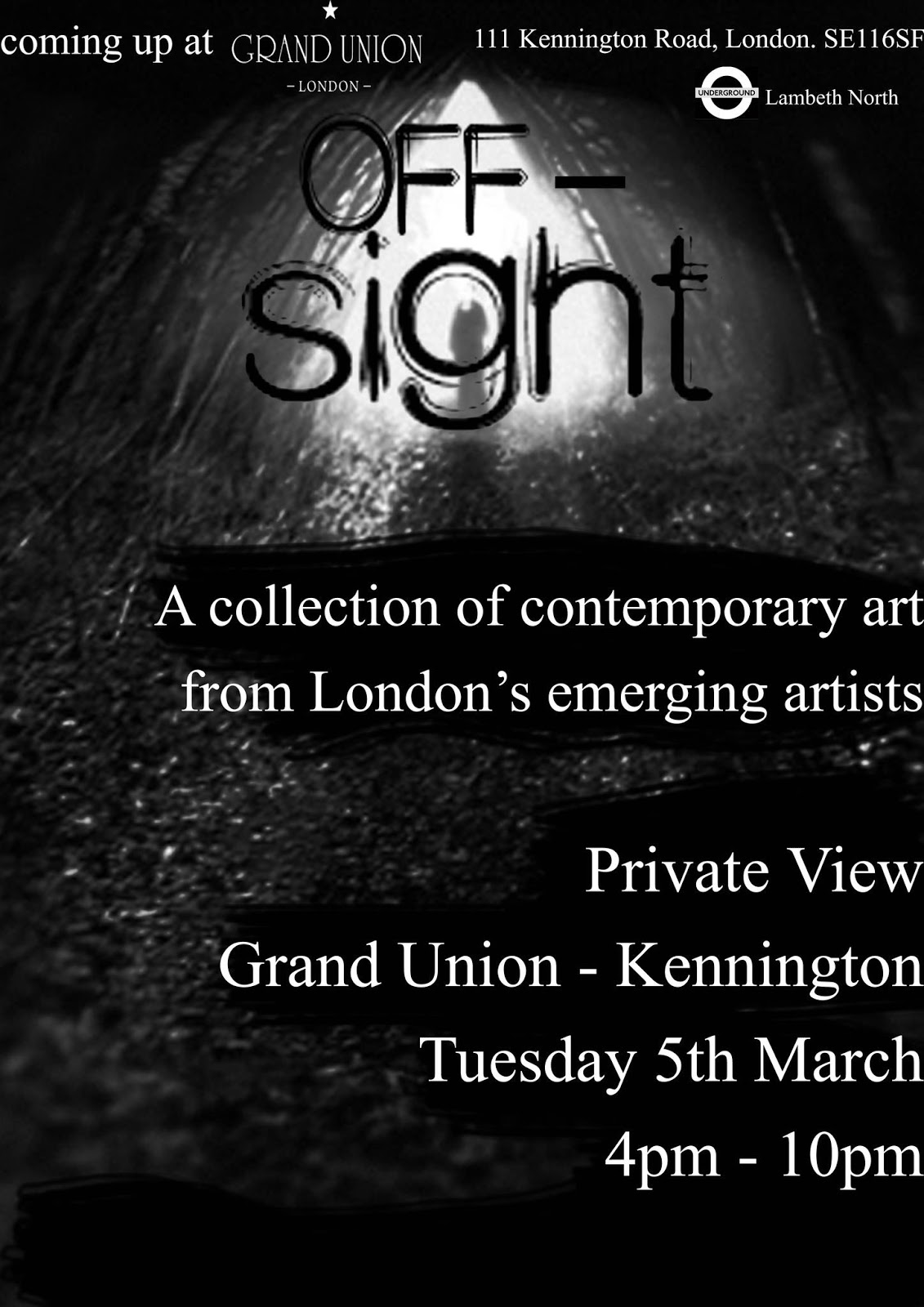
Poster for exhibition 
We came up with the name Off sight exhibition just to play on the task we had been given to have an off site exhibition. Simone designed the posters and came up with a few of options and we went with the one above.

poster option

poster option

On the day of the exhibition we had from 12 o'clock till 5 o'clock to set up the exhibition. We had to remove all the paintings off the wall and and move all the furniture and tables and chairs out apart from the ones we wanted. It was a real push to finish in time for 5 for our crit especially for Jo who had a lot of construction to do.
rough floor plan of our exhibition 
My video installation
drawing of my installation due to poor picture
This is a video of my work it doesn't quite show how impacting the flashing of the work and the dominance it had in the space. I had to make sure I put a warning about flashing lights on the door of the exhibition.


Beth's work of a video of alive sperm in semen. 
Video of Beth's work showing alive sperm in semen and dead sperm in semen growing bacteria.


This is one of three of Simone's drawings. Her three drawings document her standing on shoes that she had attached stilts onto the bottom so they were really tall and hard to balance on. She also showed the shoes she had made for this exhibition. This photo doesn't show them very well as I didn't have a flash on my camera and I should have brought a proper camera to document the exhibition better.


These are videos of Jo's work she made a corridor from wood and black fabric and set up a motion sensor light behind two fish bowls full of water, so when a person when through the light turned on and created a rippling effect on the opposite fabric 'wall'.

At 5 o' clock we had our tutor group and tutor come to look round our exhibition and have a crit. I always struggle with our crits as our group isn't the most talkative and it's sometimes really hard to get people to talk and make any sort of comment and its generally the same people that only talk which includes me and Jo. However we got some good feedback and discussed each of our works and how they worked in the space and how we set up the  exhibition. They commented on how:


  • the amount of works in the space works well as they all have enough breathing space so they are not competing for attention  and that it seems well balanced. 
  • My piece is what impacts you first when you enter the room as its what hits you when you walk in if the main video bit is playing. It sets the tone for the rest of the exhibition as it was generally what people encountered first. 
  • the whole exhibition makes you aware of your body and references your physicality (which is something we hadn't realised before) due to the use of eating disorders in my piece and the food on offer to eat whilst watching the videos, Simone's work relating to physical movement of her body trying to balance on the shoes, Beth's semen which is a bodily fluid, and Jo's work that responds to your bodies presence. 
  • the exhibition has some sort of extreme distorted element to it which echos the potential over indulgence, hedonism, alcoholicness of the bar and added to the unsettling effect of some of the works. 


Sunday, 17 March 2013

Mind Fuck

I went to Bruce Nauman's Mind Fuck exhibition at Hauser & Wirth a few weeks ago.

'The artist once stated that he wished to make ‘art that was just there all at once…like getting hit in the back of the neck with a baseball bat’.'

This exhibition shows works focusing on his interests of , life, death, sex, agression, language and psychoanalysis.


This room you had to squeeze through a gap t get through and out making you feel like your trapped a bit in this green hell. I went with my friend Jo and I can't tell you how awful she looked green. It was like having been abducted by aliens or something. Waking up and not knowing where you are in this strange surreal green world where you are conscious there is no easy escape.


This is made based on casts from taxidermy animals. They are dragged round in a lifeless way or like they have just given in or up to the monotonous circle they are tracing.  "endless chase" "wearily rotating" . Originally the objects are meant to scrape and drag along the concrete floor making a screeching noise however they now scuff against MDF. This is in attempt to conserve the piece. I think it would have been a lot more effective without the MDF as it would have been a much more painful experience. 

 Here the neons flack on on of changing between men and woman, mouths open and mouths closed. constant changing, nothings stable or steady about it.

This is Good boy, Bad Boy, I originally saw this in video form at Tate Liverpool. Here it is in neon form constantly flashing on and of changing the amount of information shown not leaving really any time in-between to reflect on each statement shown, you're strait on to the next one. Or if your given more than one phrase it's hard to manage to read them all at once. It's really bright assaulting your eyes.  

'Nauman has used the medium of lights and bright colours to create an unsettling vision for the viewer, akin to bouts of psychosis and mangling of the mind, looking to dream interpretation as a huge influence. His work sprang out of an era of popularity in Gestalt therapy and behaviourism, of observation over symbolism, creating a body of work that pushes the viewer into an uncomfortable position as observer of human action.'

Nauman is such an important artist to me as in many ways he wants to achieve what I want to achieve through my work. The unsettling vision for the viewer, the mangling or the mind, pushing the viewer into an uncomfortable position, something that is like being hit in the back by a baseball bat. 

http://www.guardian.co.uk/artanddesign/video/2013/jan/30/bruce-nauman-art-video-review  

Thursday, 14 March 2013

Essay - Issues of authorship and originality in relation to the use of appropriation in contemporary art.

This is my essay I wrote I where I set the question and initiated my own research behind it. I choose tis subject as it addresses issues surrounding my work.


Issues of authorship and originality in relation to the use of appropriation in contemporary art.

Appropriation artist’s use of other artist’s works and sources brings up issues and questions surrounding the notions of authorship and originality. It has been said that appropriation artist’s authorship relation to their work appears compromised from the very start due to the inclusion of other people’s works. Some appropriation artists themselves have also declared that there is no such thing as originality, particularly traditional notions of originality in an age of technical innovation and easy reproduction.

Appropriation is a practice that goes back far in history for different purposes. Albrecht Durer originally set the paradigm for what a Rhinoceros looked like for people in Europe who had never seen one before. He made a drawing of a Rhinoceros from vague sketches and a description; this drawing became the set image for rhinoceroses in his work and other artist’s works that wanted to include a rhinoceros. However with these artist’s works there didn’t appear to be a problem of authorship and originality with their inclusion of Durer’s rhinoceros as they were just seen as using the accepted depiction of rhinoceros.

Artists such as Pablo Picasso and Georges Braque in the early twentieth century appropriated images from newspapers in their cubist collages. Issues of authorship with these works weren’t as apparent as more recent artists that are classified under the umbrella of appropriation artists. Authorship and originality became more of an issue as artists started to use appropriation in more extreme ways in some cases as a way to directly challenge these terms. Elaine Sturtevant took appropriation art to more extreme levels; she replicated artist’s work such as Andy Warhol, Claes Oldenburg, Roy Lichtenstein and Marcel Duchamp through the process they were originally created. Her works tip traditional ideas of originality and authorship on its head.

Roland Barthes  (1) tells us that to impose an author on a work is to impose a limit on the work. He says ‘the birth of the reader must be ransomed by the death of the Author.’ Sherrie Irvine (2005) asks “The work of the appropriation artists, which continues into the present, might well be thought to support the idea that the author is dead: in taking freely from the works of other artists, they seem to ask, with Foucault, ‘What difference does it make who is speaking?’” Through the use of appropriation the author may appear to be dead however the importance of the author seems more apparent and although the author may be challenged, it is not dead.

This is particularly evident in Sherrie Levine’s Work where she photographed Walker Evans’ photographs from an exhibition catalogue and re-presented them in an exhibition as her work. Here the author of the work becomes very important to establish, as knowing the author completely changes your understanding and reading of it. In visual terms the works of Walker Evans and the appropriated images of Evans’ photos by Sherrie Levine are the same. However they have been through different processes and were made under different intentions and contexts. Walker Evans was documenting the effects of the great depression and had to consider and work through issues and concerns, such as composition, lighting, the subject and so forth. Whereas Levine has re-photographed his photos to make a commentary on photographic reproduction, artistic originality, authorship and authenticity. “[She] wanted it understood that she was flatly questioning questioning-no, flatly undermining-those most hallowed principles of art in the modern era: originality, intention, expression” (Rimanelli, David, 1994). Levine creates a whole new concept for ‘Evans’’ photographs, they wouldn’t be considered as new works and this concept wouldn’t be apparent if the author was not known and recognized as we would just assume they were Evans’ images. So we can see here for the reader (audience) to be empowered it does make an important difference as to who is speaking.

On the other hand With Pierre Bismuth’s piece ‘Blue Monk in Progress’ the issue of the author comes across in a different way. He used a Yamaha Disclavier piano that can record a player’s performance and then recite it back. Pierre Bismuth used this to record him learning to play Thelonious Monk’s piano piece ‘Blue Monk’. He then had this performance written as musical notation with all the errors, which he then got a professional pianist to play on the Disclavier piano. The pianist played the piece according to the musical score like the errors of Bismuth were intentional and were meant to be in the piece. The final work that was exhibited was of the Disclavier playing back what the pianist had played on it.

In this piece of work the authorship can be interpreted in different ways. Is Bismuth the author as he was the one who’s idea it was to do this piece of work and organize it? Is Thelonious Monk the author, as his piece ‘Blue Monk’ is a key part and center of the work? Is the Pianist the author as it is their recording recital that is played? Is the Disclavier piano the author, as it is the disclavier that when it comes down to it, when the work is exhibited, that actually plays the piece? Or is it a combination of all of them? This piece may be seen to have different authors, that may be disputed but establishing the author and knowing who is speaking here may not be so important compared to Sherrie Levines work. Knowing the process of the work and leaving it to the audience to decipher and interpret is more interesting.


As we can see with Bismuth’s work there is some debate as to who actually is the author when an artist’s work consists of other peoples work. Normally artists are held responsible for every aspect and decision made within their work. However when an artist appropriates someone else’s artwork they are not responsible for every feature, as someone else has created them through their decisions.  This questions the work’s author and the originality of the new work, as it does not wholly originate with the ‘new’ artist. Although large parts of appropriations works may not originally be features created by the appropriation artist it doesn’t mean necessarily that they are not the authors of the new work or that it is not original.

 Elaine Sturtevant makes a point about her work and the issue of copying, “There’s a big difference in repeating in the sense of Deleuze, and copying. Firstly, a copy must be absolutely of the same intention as the original, whereas my work deals with an interior movement, and repetition as difference.” (OBRIST, HANS ULRICH, 2009.) This can be applied to other appropriation artists works to when arguing who is the author. The different processes, intention, context and transformation of the appropriated work establish the work as something substantially different from the original and so asserts the authorship of the creator of the appropriated work. This shows how Sherrie Levine is the author of her work, as even though her work of appropriated images by Walker Evans are visually the same as Walker Evans’ originals, Levine is the author of her work as she created the work with new intentions and concepts that’s originate with her. Further more society has accepted such appropriation artists as the author of their work and they have been recognized and have received awards as successful artists. Elizabeth Price recently won the 2012 Turner Prize for her piece ‘The Woolworths choir of 1979’ which was made up of appropriated archival footage edited into the award winning piece. Also many appropriation artists have had exhibitions and have their work held at prestigious institutions, which wouldn’t have happened if the artist weren’t taken seriously as the authors of their work.

Appropriation may ‘copy’ other artist’s work but it isn’t forgery. John Myatt painted copies by famous painters such as Monet and originally sold them as ‘genuine fakes’. However with the help of John Drewe he realised he could sell them as the genuine article for a lot more money. He created over 200 fakes that were sold but they were both found out, were convicted and spent time in prison. Myatt now has returned to selling his paintings as genuine fakes. Here we can see that forgery differs from appropriation as the forger tries to pass their work off as the original work for financial gain, not artistic purposes.

Even though appropriation isn’t forgery there are still cases where the law gets involved where copyright is concerned. There is a fair use act for the use of other people’s copyrighted work. If a work is deemed transformative it is not seem to be in breech of copyright, however what is considered as transformative is disputable. Jeff Koons was sued for his use of Art Rogers’ photo of a man and woman holding some puppies called ‘Puppies’. Koons instructed Italian artisans to make a 3d sculptural replication of the image entitled ‘String of Puppies’. “Koons claimed that artistic freedom would be abrogated if artists could not make parodies or create work that somehow showed the influence of other artists.” (Grant, Daniel, 2012) The court ruled against Koons deeming that the piece didn’t parody the original work. Even though this piece of work may have not parodied the original work it was transformative and original, seen as the medium was changed and it was made into a 3d work which didn’t look exactly the same as the photo and would have been experienced in a completely different way. In the artistic world the change of medium would have been considered as transformative but the ordinary viewer has to be able to see it as transformative and that was not apparent in this case.

Some philosophers have proposed that originality be understood in relation to the properties of a work. “Frank Sibley (1985) equates originality with "novelty," and he analyzes various senses of originality in terms of the properties of the work, namely, that it "differs from anything previously existing in relevant ways."”(Van Camp, Julie C, 2007) Returning to koons’ work, his work may not have been seen transformative enough but according to this it is original as it differs from anything previously existing as his work features in a form that the photo had not existed in before, which then would have created a new experience of the work.

James Elkins focuses exclusively on properties of works in relation to others, a work is original if it has one of these senses. “First, what he calls "originary," are works "that appear to be without antecedent" (…) This seems to approximate "novelty" in the sense of being historically first, dependent on placing the work in a historical context as the first to demonstrate a certain trait. The second sense, "primacy," "refers mostly to itself," and also seems to connote novelty as a historical fact. (…) The third, "uniqueness," refers to the qualities that distinguish an object from copies” (Van Camp, Julie C, 2007)

If we take this definition or originality we can see how appropriation art can be considered as original. Taking example from Sherrie Levine’s work again we can see that her work is original, as in a historical context she was one of the first to appropriate in such an extreme way in photographing someone else’s photography and the result being visually the same as the original photographers images. Furthermore her work identifies with the third sense, as her works are distinguishable from Evan’s photos as they posses different qualities, primarily concept.

This shows that originality does still exist and here we can see that a work of art, in particular appropriation art, may not be original in the traditional sense but can be original in a new sense. All work is derivative somehow of other things but it is the new qualities that an appropriation artists adds to a work that can make it original. This also applies to them asserting their authorship on their work, as they are the creators of something new and this shows that the author can still be important to a piece of work.


Bibliography


Baudrillard, Jean, 1983, Simulations, Semiotext(e) Foreign agents sense, New York,

Benjamin, Walter, 2008, The work of art in the age of it technical reproducibility and other writings on media, The Belknap press of Harvard University, London (1)

Sonvilla-Weiss, Stefan, 2010, Mashup Cultures, Springerwien, New York

Van Camp, Julie C, 2007, Originality in Postmodern Appropriation Art. Journal of Arts Management, Law, and Society. 36 (4), 247-258..
Posker, Dan & Patience, Cameron, 2010, Appropriation Art: an overview of copyright and consumer protection for artists, Arts Law, available from: http://www.artslaw.com.au/articles/entry/appropriation-art-an-overview-of-copyright-and-consumer-protection-for-arti/ [accessed 3rd march 2013]
Weaver, Cat, 2011, Law vs. Art Criticism: Judging Appropriation Art, Hyperallergic, available from: http://hyperallergic.com/23589/judging-appropriation-art/ [accessed 25th February 2013]
Rowe, Hayley, 2011, Appropriation in Contemporary Art, Student Pulse, Available from: http://www.studentpulse.com/articles/546/appropriation-in-contemporary-art [accessed 15th February 2013]

Benjamin, Walter transcribed by Blunden, Andy, 2005, The Work of Art in the Age of Mechanical Reproduction, Marxists, Available from: http://www.marxists.org/reference/subject/philosophy/works/ge/benjamin.htm [accessed 12th February]

2013, Appropriation (art), Wikipedia, Available from: http://en.wikipedia.org/wiki/Appropriation_(art) [accessed march 1st]

Barthes, Roland, Death of the Author, tbook, Available from: http://www.tbook.constantvzw.org/wp-content/death_authorbarthes.pdf [accessed 28th February]

Diva, Mac, 2004, Cultural appropriation: Who’s music is it anyway?, Blog Critics, available from: http://blogcritics.org/music/article/cultural-appropriation-whos-music-is-it/  [accessed 2nd March]

Irvin, Sherri, 2005, Appropriation and Authorship in Contemporary Art, Draft for British Journal of Aesthetics, 45, 123-137.

Saturday, 23 February 2013

Tutorial - 11/02/13


What are the aims, intentions and interests that you are exploring through your practice/written work?

  •    something that impacts on and effects the audience the audience + makes their suffering come across.

  • using appropriated images / footage based on eating disorders and the mental disturbances of it. particularly emphasising on footage found on rhodes farm.

  •  Highlighting aspects of their illness or discomfort

  •  I want to make something unpleasant/ disconcerting/ attacking to watch and experience.

Describe three issues in your practical/written work that you need to address and discuss in your tutorial    
  •   Whether the topic of eating disorders is important to me and/or what im trying to achieve with my work
  • Booking out a project space – what I should show in it, how should I arrange it 
  •  Trying out multiple screens
Agreed Actions

  • monika oeschler - video
  • fat is a feminist issue - susie orback
  • book space - email ersan turk + katrine - look what space i want 
  • kutlug atsman - video installation 
  • julie kristeva - abject 
  • maria walsh 
  • make on footage ?

I showed this video as well which actually isnt finished 
.......


Jean Baudrillard and Simulation - the copy

We had a lecture the other day which was very relevant to my work and my essay that I'm currently writing. Due to it's relation to appropriation and the copy.

The idea of the copy 

  • uncanny repetition 
  • feelings of deception and anxiety 
  • de-establishing singularity 
  • with the twin towers they had to destroy both of them to make it meaningful - with this though we weren't seeing anything new it was a replication of a hollywood film.
  • blurring between reality and fantasy 
  • Plato said reality lives in a world of ideal forms 
  • we see a world of shadows 

  • Albrecht Durer replicated his work but his signature made it original
  • He set what a rhinoceros looked like as he drew one from a description and other artists would look to his drawing and replicate it in their work as they didn't know what a rhinoceros looked like - but there copy is still original in their work

  • Eduard Manet - portraiture - he wanted to make a copy of life and not make n idealistic image. 
  • Georges Seurat - turns painting into something mechanical like photography - which copies life and is made up of tiny dots, so he painted in dots
  • Roy Lichtenstein-relates to 4 colour printing of dots, pokes fun at authenticity and looks at pop culture and comics
  • Andy Warhol - did painting by numbers works showing its mechanical process . when images are massed produced they loose their impact - eg. with his car crash images theres so many you just see the image and not the devastation 
  • Charles Ray - life size model of a model fire truck - a moment of certainty to uncertainty
  • Thomas Dernand - Makes models or real things / sites with significance and photographs them so they look actual size. 
  • Allan McCollum - Thought he didn't need to make any new pictures as theres so many already . He took pictures that he saw on the tv behind actors and photographed them and blew them up. He thinks they are surrogates of the real images and are standing in for the need to make any new images. - but he did make new images doing this !

  • At Disney World people think the have experienced something simulated and when you leave , you leave into the World of America where things are real. When really it isn't and disney world is actually showing you everything is fake.
  • Sherrie Levine - rephotographs famous photos from books.
  • Hiroshi Sugimoto - Photographs wax works to make it like a portrait of the actual person - uncanny 

  • The copy can be thought of as an issue of plagiarism but a way of thing about how to make something new, when both nothings of originality and authenticity seems open to question.

Hitachi consulting opportunity


A few weeks ago I went with a group of students for chelsea to Hitachi consulting's office at More London Riverside, which consist of some amazing modern architectural buildings by London and Tower bridge. 

We looked round the office and had a talk about the company and the opportunity we have to make some work for their offices. 

Things they want and points made - 

  • work to respond to the building/area/company/history or the way the space is used. 
  • has to be robust and be able to last a year. 
  • can't be to controversial 
  • would be good if it was a talking point.
  • reflect hitachi spirit and values
  • complements the surroundings

  • hitachi means sunrise - and the symbol is a combination of the chinese symbols for that
  • they aim to create a better society through technology as our society changes
  • they desire a reputation of being knowledgeable 
  • founded in 1910
  • 940 companies around the world  
  • hitachi consulting was born in america 

  • we have to make a proposal for our work that we would want to make for it and present it to hitachi
  • 8 people will be chosen 
  • given £250 to do the work

I have a meeting on monday to discuss our ideas we have as a group - need to think of something ! 


Tuesday, 15 January 2013

Repetition compulsion

So I was looking into the nature of compulsive and repetitive behaviour on the internet and I came across the term Repetition Compulsion which I found quite interesting.

It's a psychological phenomenon where a person repeats a traumatic event or circumstances over and over again. It includes reenacting the event or putting oneself in situations where the event is likely to happen again. It can also take the form of dreams and feelings of what happened are repeated.

The term also covers the repetition of behavioural life patterns. Freud says it describes the pattern whereby people endlessly repeat patterns of behaviours which were difficult or distressing in earlier life.

There is a lot more too this and the theory why people do it etc. but just this brief overview of it had aspects which I find really interesting in relation to making my art. I would kind of like to do this in a way in my videos with my use of repetition and reenact a traumatic event/situation/time and put that on the audience.